

Every rally in the sport starts with a serve. So understanding the table tennis serving rules is essential for players, umpires and fans alike. A single illegal toss or a hidden ball can cost you the point before the rally even begins. In this guide, you will find the official ITTF rules explained in plain language. We also cover common faults, doubles serving rules and simple ways to practise a legal serve.
We cover everything from the height of the ball toss to how many serves each player gets. You will also learn when the turn changes. This guide has the answer, whether you are a beginner or a club player checking a tricky rule.
Key Takeaways: Table Tennis Serving Rules
- The ball must start resting freely on the open, flat palm of your stationary free hand.
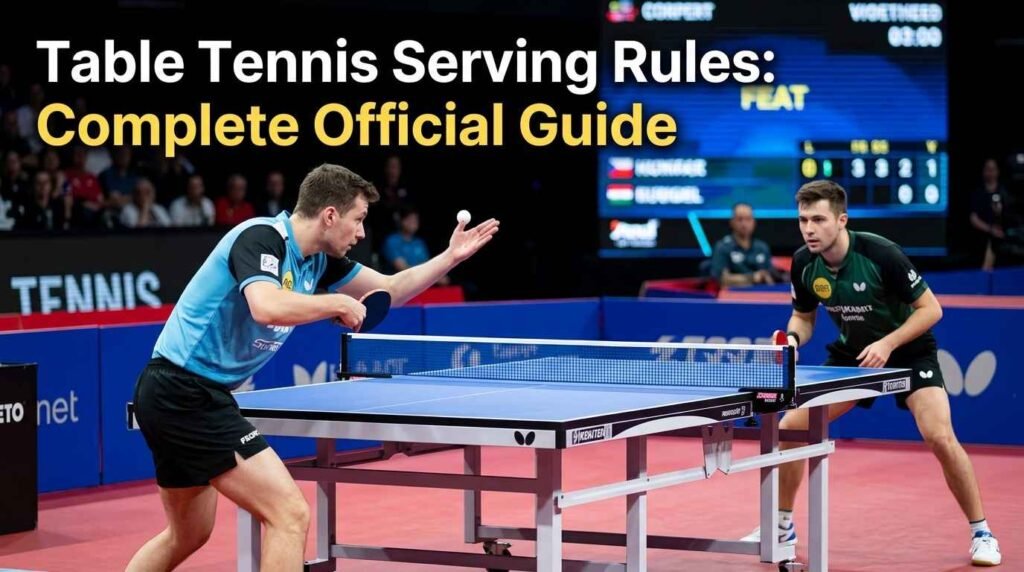
- You must toss the ball near vertically upward, without spin. It must rise at least 16 centimetres before you strike it.
- The ball must stay above the playing surface and behind your end line. It must never be hidden from the receiver.
- Each player serves two points in a row, except at 10-10 (deuce), when serving switches after every single point.
- In doubles, the serve must go diagonally from the right-hand court to the receiver’s right-hand court.
- A let is called for a service that touches the net and still lands correctly. The point is simply replayed.
Why Table Tennis Serving Rules Matter
The serve is the only shot in table tennis that one player fully controls from start to finish. Because of this, the sport’s governing body enforces strict rules. The International Table Tennis Federation (ITTF) wants every serve to stay fair and visible to the receiver. Without these rules, a server could hide the ball behind their body. They could also add extra spin unfairly, which would make the game far less balanced.
Therefore, learning the table tennis serving rules helps you in three ways. First, it keeps you from losing easy points to service faults. Second, it helps you read your opponent’s serve more confidently. Third, if you umpire or referee matches, it lets you make fair, correct calls.
The Official ITTF Table Tennis Serving Rules
The rules below come from Law 2.6 of the official ITTF Laws of Table Tennis. We explain each part step by step, so you understand not just the rule, but the reason behind it.
Rule 1: The Ball Rests on an Open Palm
Service must start with the ball resting freely on the open, flat palm of your stationary free hand. Your fingers must be together, and your thumb must be free. This rule stops players from gripping or cupping the ball. That kind of grip could hide the toss or add early spin.
Rule 2: The Free Arm Position
Your free hand, holding the ball, must be an open hand with the fingers together and the thumb free. It must be held flat, and the ball must sit still before the toss begins. If your hand shakes, curls, or the ball is not resting freely, the umpire can call a fault.
Rule 3: The Vertical Toss
You must project the ball near vertically upward, without imparting any spin. It must rise at least 16 centimetres after leaving your palm. Only after it rises to this height and begins to fall can you strike it. This rule exists to stop very low, disguised tosses that give the receiver no time to react.
Rule 4: No Contact Before the Strike
Once you toss the ball, it must fall without touching anything before you strike it. This includes your hand, your body, clothing, or the table. If the ball touches anything during its flight before contact, the serve is a fault. Your opponent wins the point.
Rule 5: Strike Behind the End Line
From the moment you begin the service action until you strike the ball, it must stay behind your end line. In addition, the ball must remain above the level of the playing surface for the entire service action. The only exception is the moment it passes over your end of the table.
Rule 6: The Ball Must Never Be Hidden
This is one of the most important table tennis serving rules. The ball must never be hidden from the receiver by any part of your body, your free arm, or your clothing. This applies at every point from the start of service until it is struck. Consequently, players cannot serve from behind their head, shoulder, or body. That position would block the receiver’s view of the toss and contact.
Rule 7: Once in Play, Normal Rules Apply
As soon as the ball leaves the server’s racket, it becomes a normal part of play. It must first bounce on the server’s side of the table. Then it must pass over or around the net and land on the receiver’s side. If any of these steps fail, the serve is a fault, unless a let applies, which we cover below.
Table Tennis Serving Rules: Where the Ball Must Land
Where the ball must land depends on whether the match is singles or doubles. This distinction confuses many new players, so it deserves its own section.
Singles Serving Rules
In singles, the server can serve from any position behind their end line. They can aim anywhere on the receiver’s side of the table. The ball simply needs to bounce once on the server’s half. Then it must clear or touch the net and land anywhere on the receiver’s half.
Doubles Serving Rules
In doubles, the rule is stricter. The service must start on the right-hand half of the server’s court. It must then land diagonally in the right-hand half of the receiver’s court, as viewed from the server’s side. If the ball lands outside this diagonal area, the serve is a fault. This applies even if it is still on the correct side of the table.
In addition, doubles partners must serve, receive and then move aside in a fixed rotation. After the first server’s two points end, the receiver becomes the new server. Then that player’s partner receives. This pattern repeats throughout the game, which keeps the doubles rotation fair for both teams.
How Many Serves Does Each Player Get?
Under the standard table tennis serving rules, each player serves two points in a row. Then the serve passes to the opponent. This continues throughout the game, alternating every two points.
The Deuce Exception
There is one important exception. When the score reaches 10-10, often called deuce, the serve switches after every single point instead of every two points. This rule keeps close games balanced. Neither player can rely on a long serving run to build a big lead late in the game.
Serving Order in a Match
At the start of each new game within a match, the serving order alternates. If Player A served first in game one, Player B serves first in game two, and so on. In the final, deciding game of a match, players also switch ends once either player reaches five points. This balances any lighting or background differences on the table.
Common Table Tennis Service Faults
Understanding the rules is one thing, but recognising a fault in real time takes practice. Here are the most common service faults players and umpires encounter.
Throwing the Ball Less Than 16 Centimetres
This is the most frequent fault among casual and beginner players. Many players toss the ball only a few centimetres, which gives the receiver very little time to read the serve. Umpires measure this by eye, and a clearly low toss is called immediately.
Serving with a Curled or Closed Palm
If your hand is not flat and open, or your fingers are not together, the ball is not resting freely. The serve is then a fault. This often happens when players try to add spin to the ball before it even leaves their hand.
Hiding the Ball with the Free Arm or Body
Some players unconsciously position their playing shoulder or head between the ball and the receiver during the toss and strike. Even if this is not deliberate, it is still a fault under the visibility rule.
Striking the Ball in Front of the End Line
The serve is illegal if a player leans forward and strikes the ball in front of their end line, rather than behind it. This can happen when players rush their service motion.
Adding Spin to the Toss
The toss itself must have no spin. Some players try to flick or spin the ball as they release it from their palm, which is not allowed. Any spin should be added only during the actual strike, not the toss.
What Is a Let in Table Tennis Serving Rules?
A let is a special situation where the point is simply replayed, without either player being awarded a point. The most common let occurs when the served ball touches the net or its supports. The ball must still land correctly on the receiver’s side. The outcome was affected by an unpredictable net touch. So the rules treat this as a neutral replay rather than a fault.
Lets can also occur for other reasons during a match, such as an interruption from outside the playing area. Still, the net-touch service let is the one most closely tied to the table tennis serving rules. When a let is called, the same player serves again, with no change to the score.
The 2002 Service Rule Change and Why It Happened
Table tennis serving rules were not always this strict about visibility. Before September 2002, players could serve with the ball partly hidden behind their body. This made some serves nearly impossible for opponents to read. The ITTF introduced a new rule that year. It required the ball to remain visible to the receiver at all times during the service action.
The goal, according to the official rule change, was simple. The serve should be an open technique, fully visible to the receiver from start to finish. This is why modern professional players toss the ball clearly above their heads, away from their bodies. Older players once served from a hidden, low position instead.
How Table Tennis Serving Rules Affect Strategy
Because the rules require an open, visible toss, players cannot rely purely on deception through hiding the ball. Instead, elite players use spin, placement, speed and disguise within the legal service motion to create difficult returns.
Spin Variation
Skilled servers change the type and amount of spin on each serve, using topspin, backspin, sidespin or combinations of these. The toss itself must be spin-free. So all of this variation comes from the angle and speed of the racket at the moment of contact, fully within the rules.
Placement and Depth
A short serve makes it hard for the opponent to attack. Left alone, the ball would bounce twice on the receiver’s side. Serving long and fast to the corners can catch a receiver off guard. Both tactics work entirely within the standard table tennis serving rules.
Disguise Through Racket Angle
The toss must be visible and spin-free. So players disguise their spin through a similar-looking racket motion for different serve types. A receiver who cannot read the racket angle at contact often misjudges the spin. Yet the serve itself stays completely legal and open.
Table Tennis Serving Rules for Umpires and Officials
Umpires play a key role in enforcing these rules fairly and consistently. Understanding their perspective helps players avoid accidental faults.
What Umpires Watch For
Officials focus on four main checks during every serve. These are the flat, open palm at the start, the toss height, ball visibility, and where contact happens relative to the end line. Experienced umpires can spot violations quickly because they watch the same sequence on every single serve.
Warnings and Point Penalties
In many competitive formats, an umpire may give a warning for a borderline or first-time fault. Repeat violations after that lead to the point being awarded to the opponent. At the highest level, clear faults are usually penalised immediately, without a warning. Professional players are expected to know the rules.
Using Video Review
At major international tournaments, officials sometimes use slow-motion video review to check disputed serves. This is especially useful for the 16-centimetre toss height and the free-hand position. This technology has made it easier to enforce the table tennis serving rules consistently, even at the highest playing speeds.
How to Practise a Legal, Effective Serve
Good technique and rule compliance go hand in hand. Use these drills to build a serve that is both legal and difficult to return.
Drill 1: The Toss Height Check
Practise tossing the ball with an open, flat palm and check that it clearly rises above 16 centimetres before falling. Use a marked wall or a partner to confirm the height until it becomes automatic.
Drill 2: Shadow Serving Without a Ball
Practise your full service motion without a ball first. Focus on keeping your body and arm out of the receiver’s line of sight. Also make sure you strike behind your end line every time.
Drill 3: Serve Placement Targets
Place small targets, such as coins or tape marks, in different zones of the table. Practise serving short to the middle, then long to the backhand corner, then long to the forehand corner. Keep the toss and contact fully legal throughout.
Drill 4: Spin Recognition with a Partner
Take turns serving different types of spin to each other. Call out the spin you think was used before returning it. This builds your ability to read serves while reinforcing correct, legal technique on your own serve.
Table Tennis Serving Rules: Frequently Asked Questions
How high must the ball be tossed in table tennis?
The ball must rise at least 16 centimetres after leaving the server’s open palm before it can be struck. This is one of the core table tennis serving rules under ITTF Law 2.6.
Can you serve with a closed fist in table tennis?
No. The ball must rest freely on an open, flat palm. Keep your fingers together and your thumb free before the toss. A closed or curled hand results in a service fault.
How many serves do you get in table tennis before it switches?
Each player serves two points in a row before the serve switches to their opponent. The only exception is at 10-10, when the serve switches after every single point.
What happens if the serve touches the net?
It is called a let if the served ball touches the net or its supports but still lands correctly on the receiver’s side. The point is simply replayed, and the same player serves again.
Where must the serve land in doubles table tennis?
In doubles, the serve must start from the right-hand half of the server’s court. It must then land diagonally in the right-hand half of the receiver’s court.
Can the ball be hidden during a table tennis serve?
No. The ball must remain visible to the receiver at all times. This runs from the start of the service motion until it is struck. Hiding it with the body, arm or clothing is a fault.
Is spin allowed on the toss itself?
No. The toss must be near vertical and completely free of spin. Spin can only be added at the moment the racket strikes the ball, not during the toss.
Where must a player stand to serve in singles?
In singles, there is no fixed left or right side requirement. The server can serve from any position behind their end line. The only requirement is that the ball lands anywhere on the receiver’s side of the table.
A Brief History of Table Tennis Serving Rules
Table tennis, also known as ping pong, has been governed by the ITTF since the organisation’s founding in 1926. Over the decades, the rules around serving have changed several times to keep the game fair as players’ techniques improved. The most significant change came in 2002, when the visibility requirement was introduced to stop hidden, deceptive serves.
These changes reflect a broader pattern in racket sports, where rule-makers adjust laws as equipment and technique evolve. You can read more about the sport’s development on the Wikipedia table tennis overview. You can also track current rankings on the official ITTF rankings page.
Table Tennis Serving Rules vs Other Racket Sports
Comparing table tennis with other racket sports helps highlight what makes its serving rules unique. In tennis, the server can toss the ball to any height. There is no requirement to keep it visible to the receiver in the same way. In badminton, the serve must stay below waist height and travel diagonally. This is similar in spirit to the table tennis doubles rule, but with very different technical requirements.
Table tennis is played at extremely close range and high speed. Its serving rules focus heavily on visibility and fairness, more so than most other racket sports. This is part of why the 2002 rule change was considered such an important moment in the sport’s history.
Equipment Rules That Affect a Legal Serve
The table tennis serving rules are not only about body position and toss height. The ball and racket you use also matter. Illegal equipment can turn an otherwise correct serve into a fault, or affect how the game is scored.
Approved Balls
Competitive matches use an approved 40mm plastic ball, as listed on the official ITTF equipment page. Using a non-approved ball in a sanctioned event can lead to a match being disallowed. This can happen even if every serve was technically legal.
Racket Colour Rules
Your racket must have one red and one black rubber side, in different, approved colours. This lets the receiver see which side struck the ball. A server who switches racket sides mid-serve can hide which surface made contact. This can raise fairness concerns under the broader spirit of the visibility rule.
Clothing and Accessories
The rules require the ball to stay visible throughout the toss and strike. So loose clothing, bulky sleeves or anything that could obstruct the receiver’s view may draw an umpire’s attention. Most competitive kit is designed with this rule in mind.
How Table Tennis Serving Rules Apply in Different Formats
The core service law stays the same across formats. A few related rules shift slightly depending on how the match is structured.
Best-of-Five and Best-of-Seven Matches
In a best-of-five or best-of-seven match, the serving order set at the start carries through every game. Who serves first simply alternates each game. The two-serve rotation and the deuce exception apply identically in every single game of the match.
Team Events
In team competitions, each individual match within the tie still follows the same table tennis serving rules. Team captains often brief players beforehand on serve strategy against a specific opponent. The legal service motion still allows huge tactical variety within the rules.
Wheelchair Table Tennis
Wheelchair table tennis follows the same core serving rules. Reasonable adaptations apply for players who cannot stand during their service motion. The open palm, spin-free toss and visibility requirements remain the guiding principles, adjusted for a seated position.
Table Tennis Serving Rules in Major Tournaments
Serving standards are enforced most strictly at major international events, where officials and technology work together to protect fair play.
World Championships and Olympic Table Tennis
Umpires at events such as the ITTF World Championships and the Olympic Games are specially trained. They spot subtle service faults at very high speed. Matches are broadcast globally. So consistent enforcement of the table tennis serving rules protects the credibility of results at the highest level.
How Broadcasts Highlight the Rules
Slow-motion replays during televised matches often show the toss height and hand position clearly. This has helped fans better understand these rules over time. Commentators frequently reference the 16-centimetre toss rule when explaining a close service call to viewers.
Table Tennis Serving Rules for Beginners and Recreational Players
Casual and recreational games do not always follow every rule with strict precision. Even so, learning the official standard helps beginners build good habits from the start.
Why Learn the Full Rules Even for Casual Play
Habits formed during casual play can be hard to unlearn. This matters if you plan to join a club or enter a tournament later. Practising a fully legal toss and open service motion from day one pays off. You avoid having to relearn your technique under competitive pressure.
Simple Checklist for New Players
- Start with the ball flat on your open palm, fingers together.
- Toss it straight up, without spin, so it clearly rises above 16 centimetres.
- Keep your body and arm out of the way so your opponent can see the ball at all times.
- Strike the ball only after it has started falling, and only while it is behind your end line.
- Remember: two serves each, switching to one serve each at 10-10.
Follow this checklist consistently in practice. Legal serving will feel automatic by the time you play your first competitive match.
Table Tennis Serving Rules: A Quick Reference Table
Use this table as a fast lookup whenever you need to check a specific rule during practice or a match.
| Rule Area | Requirement |
|---|---|
| Starting position | Ball rests freely on an open, flat, stationary palm |
| Toss height | At least 16cm, near vertical, no spin |
| Contact point | Behind the end line, above the playing surface |
| Visibility | Ball never hidden by body, arm or clothing |
| Serves per turn | Two points each, one point each from 10-10 |
| Doubles landing zone | Diagonally, right-hand court to right-hand court |
| Net-touch serve | Called a let; point is replayed |
Print or save this table for quick reference during coaching sessions, club nights or umpiring duties.
Frequently Missed Details in Table Tennis Serving Rules
Even experienced players sometimes overlook a few smaller points within the official rules. These details are worth knowing, since they occasionally decide close matches.
The Ball Must Rest Freely, Not Just Sit on the Palm
Some players rest the ball on their palm but keep slight tension in their fingers or wrist. That tension technically does not meet the “resting freely” requirement. A truly relaxed, flat, open palm avoids any doubt.
Above the Playing Surface, Not Just Behind the Line
Players sometimes focus only on staying behind the end line. They forget the ball must also stay above table level throughout the service motion, except when passing over their own side. Letting the ball drop below table height during the toss can also be called as a fault.
Free Hand Position After the Toss
After releasing the ball, the free hand and arm must move out of the way quickly. They must not block the receiver’s view of the strike. A slow or lingering free arm is a common, avoidable cause of service faults, especially among newer players.
More Sports Coverage on Our Network
If you found this guide to table tennis serving rules useful, explore more sports content across our network. Sports Tamasha covers cricket, football and other major games with daily updates. Sports News Era brings fast match reports and breaking sports news. Sports Dastak adds analysis, trending stories and player profiles from around the world.
Together, these three sites give you a complete view of the sports calendar. That spans cricket and football to Olympic sports like table tennis. Visit them often for fresh rule guides, match previews and results.
Final Thoughts on Table Tennis Serving Rules
The serve may only take a second or two. Yet it is governed by some of the most detailed rules in the entire sport. Understanding the open palm, the 16-centimetre toss, the visibility requirement and the doubles diagonal rule will help you avoid needless faults. It will also help you read your opponent’s serves with more confidence.
Keep this guide bookmarked as a quick reference. A solid grasp of the table tennis serving rules will serve you well, on and off the table. That holds true whether you are training for your first club match or umpiring a local tournament.