


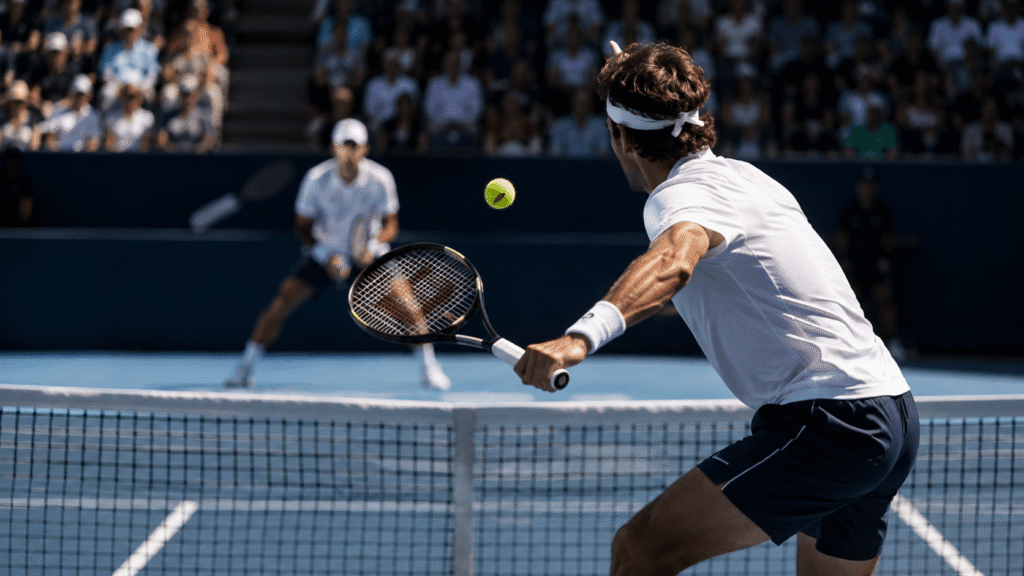
Tennis combines explosive athleticism with a scoring system that can baffle newcomers at first glance. Terms like love, deuce, and advantage do not follow the conventions of most other sports, yet once understood, they reveal a system carefully designed to create tension and drama at exactly the right moments. This guide breaks down how tennis scoring works and introduces some of the strategic ideas that separate good players from great ones.
How Tennis Scoring Works
A tennis match is broken into games, sets, and points. Within a game, points progress from love, meaning zero, to fifteen, thirty, and forty, with the first player to reach four points, while leading by at least two, winning the game. If both players reach forty, the score is called deuce, and a player must then win two consecutive points to take the game, the first of which grants advantage before the decisive point secures the game.
Games are grouped into sets, with a player needing to win six games, again by a margin of two, to claim a set. If the score reaches six games apiece, a tiebreak is typically played, where players race to seven points, or more if needed, to decide the set. Matches are usually played as best of three sets for most tour-level women’s matches and many men’s matches, while men’s Grand Slam matches are traditionally played as best of five sets.
Latest Sports News
Surfaces and How They Change the Game
Tennis is unusual among major sports in that it is played on several distinct surfaces, each with its own characteristics. Clay courts produce a slower ball bounce and higher bounce height, favouring players with strong baseline consistency and physical endurance. Grass courts offer a faster, lower bounce, historically rewarding serve-and-volley tactics, though modern racket and string technology has somewhat reduced this advantage. Hard courts sit between the two extremes and are the most common surface at the professional level.
Understanding how surface affects strategy helps explain why certain players excel at some tournaments more than others, and why a player’s style, whether built around powerful groundstrokes, clever variety, or aggressive net play, can be better suited to one surface over another.
Basic Strategy and Shot Selection
At its core, tennis strategy revolves around creating and exploiting space on the court while limiting the time and angles your opponent has to work with. A well-placed shot deep into the corner can push an opponent out of position, opening up the rest of the court for a winning shot on the next exchange.
Players generally choose between baseline strategies, grinding out rallies from the back of the court, and more aggressive approaches that look to shorten points by coming to the net or hitting powerful, flat shots. Modern professional tennis has increasingly blended these approaches, with even natural baseliners incorporating net play and drop shots to disrupt an opponent’s rhythm.
The Serve: Tennis’s Most Important Shot
The serve is unique in tennis because it is the one shot a player controls entirely, without needing to react to an opponent. A strong first serve can set up an entire point, either through an outright ace or by forcing a weak return that allows the server to dictate the following exchange.
Players get two attempts on each point; if the first serve misses, a more conservative second serve typically follows to avoid a double fault, which concedes the point outright. The balance between aggression and consistency on serve is one of the most closely studied aspects of professional tennis analytics today.
Mental Toughness in Tennis
Because tennis offers no clock and no teammates to lean on, matches can hinge entirely on a player’s mental resilience. A single lapse in concentration at a crucial moment, such as serving for the match, can shift momentum dramatically, and the sport is littered with famous comebacks built on composure under pressure rather than technical superiority alone.
This mental dimension is part of what makes tennis so compelling to watch. Commentators frequently discuss a player’s body language and on-court demeanour as much as their shot-making, because both genuinely influence outcomes at the highest level.
Getting Started as a Player
For those inspired to pick up a racket themselves, beginner lessons typically focus on grip, footwork, and consistent contact before introducing more advanced shot types. Many clubs offer group cardio tennis or beginner clinics that build fundamental skills in a lower-pressure, social environment, which tends to be far more enjoyable than attempting to learn the sport entirely through solo practice.
Whether you end up playing socially or simply watching from the stands, understanding the scoring system and the strategic battles playing out point by point transforms tennis from a confusing string of unfamiliar terms into one of the most tension-filled and skilful sports to follow.