

The Los Angeles Dodgers and Boston Red Sox delivered one of the most closely watched interleague series of the 2026 MLB season, and anyone searching for Dodgers vs Red Sox match player stats wants one thing: the real numbers, not vague recaps. This article breaks down every game of the series pitch by pitch, stat by stat — full box scores, home run tallies, pitching lines, and the individual performances that decided each result — so you get a complete, single-page reference for the entire series.
Quick Answer: Series Result at a Glance
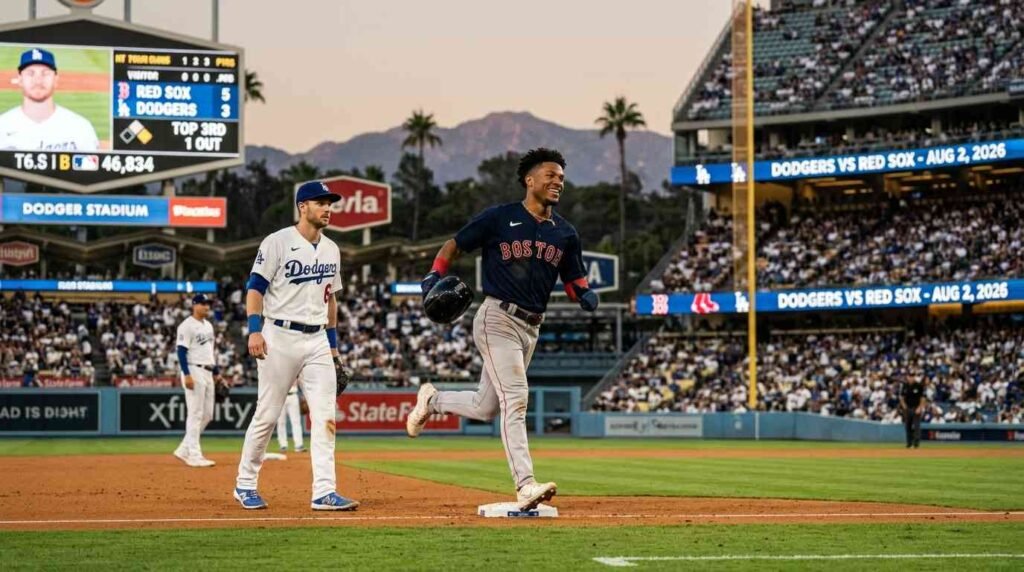
The Boston Red Sox swept the Los Angeles Dodgers 3-0 in a three-game series played at Dodger Stadium from July 31 to August 2, 2026.
| Game | Date | Final Score | Winning Pitcher | Losing Pitcher |
|---|---|---|---|---|
| Game 1 | July 31, 2026 | Red Sox 9, Dodgers 4 | — | — |
| Game 2 | August 1, 2026 | Red Sox 3, Dodgers 2 | — | — |
| Game 3 | August 2, 2026 | Red Sox 8, Dodgers 4 | J. Bennett (7-4) | E. Sheehan (4-8) |
Boston outscored Los Angeles 20-10 across the three games, extending their own winning streak to five games and improving to 23-3 since July 3 — one of the best stretches of baseball played by any team in the league at that point in the season.
Game 1 Recap: Red Sox 9, Dodgers 4 (July 31, 2026)
Boston opened the series with a come-from-behind win, rallying from an early deficit with a five-run seventh inning to beat Los Angeles 9-4 at Dodger Stadium in front of 47,903 fans.
Game 1 Team Stats
| Stat | Red Sox | Dodgers |
|---|---|---|
| Hits | 12 | 10 |
| Home Runs | 1 | 1 |
| Total Bases | 17 | 14 |
| Runners Left On Base | 10 | 7 |
| Game Time | 2:53 | — |
Game 1 Player Stats
- Ceddanne Rafaela (Red Sox): Delivered the go-ahead two-run homer that highlighted Boston’s five-run seventh inning, the single biggest swing of the game.
- Jarren Duran (Red Sox): Drove in two RBIs during the decisive rally.
- Willson Contreras (Dodgers): Left the game after being hit in the helmet by a 95.4-mph pitch in the third inning. Initial concussion tests were reported to have “gone fine,” though he underwent further testing the following day.
- Winning Pitcher Line: 4.0 IP, 3 H, 0 ER, 3 K, 1 BB
- Losing Pitcher Line: 6.0 IP, 8 H, 6 ER, 5 K, 3 BB
This win extended Boston’s remarkable July form — the club finished the month 21-4, an .840 winning percentage that stood as the best in franchise history for any calendar month with a minimum of 15 games played.
Game 2 Recap: Red Sox 3, Dodgers 2 (August 1, 2026)
Boston followed up with an even tighter win, edging the Dodgers 3-2 in a late-inning thriller at Dodger Stadium, with a game time of 2:09 in front of 49,291 fans.
Game 2 Team Stats
| Stat | Red Sox | Dodgers |
|---|---|---|
| Hits | 4 | 10 |
| Home Runs | 2 | 1 |
| Total Bases | 11 | 14 |
| Runners Left On Base | 1 | 7 |
Game 2 Player Stats
- Andruw Monasterio (Red Sox): Hit a ground-rule double to lead off the eighth inning and scored the go-ahead run on a double-play grounder off the bat of Connor Wong.
- Shohei Ohtani (Dodgers): Hit a home run in the fifth inning to briefly give the Dodgers the lead, before Boston’s offense responded late.
- Yoshinobu Yamamoto (Dodgers): Started for Los Angeles after skipping the All-Star Game to get extra rest — a decision that appeared to pay off in the quality of his outing.
- Payton Tolle (Red Sox): Announced as Boston’s Game 3 starter, riding a stretch in which the team had won each of his last four starts, going 2-0 with a 3.05 ERA over that run.
Despite outhitting Boston 10 hits to 4, the Dodgers left seven runners on base compared to just one for the Red Sox — a stark efficiency gap that decided a game LA arguably dominated statistically but still lost.
Game 3 Recap: Red Sox 8, Dodgers 4 (August 2, 2026)
Boston completed the sweep with an 8-4 win on Sunday night, in front of 46,834 fans, with a game time of 3:09.
Game 3 Team Stats
| Stat | Red Sox | Dodgers |
|---|---|---|
| Hits | 9 | 9 |
| Home Runs | 4 | 0 |
| Total Bases | 21 | 11 |
| Runners Left On Base | 9 | 7 |
Game 3 Player Stats
- Ceddanne Rafaela (Red Sox): Homered for the third straight game, capping a dominant series performance.
- Masataka Yoshida (Red Sox): Homered and drove in two runs.
- Wilyer Abreu (Red Sox): Went deep as part of Boston’s four-homer outburst.
- Jarren Duran (Red Sox): Added Boston’s fourth solo homer of the game in the sixth inning.
- Jake Bennett (Red Sox, Winning Pitcher): Improved to 7-4 after allowing three runs across 5⅔ innings. Full line: 5.2 IP, 6 H, 3 ER, 4 K, 2 BB
- Emmet Sheehan (Dodgers, Losing Pitcher): Fell to 4-8 after allowing five runs in just 2⅔ innings. Full line: 2.2 IP, 6 H, 5 ER, 4 K, 1 BB
Home Run Leaders — Game 3
| Player | Team | Season HR Total |
|---|---|---|
| Ceddanne Rafaela | Red Sox | 15 |
| Wilyer Abreu | Red Sox | 17 |
| Masataka Yoshida | Red Sox | 5 |
| Jarren Duran | Red Sox | 14 |
RBI Leaders — Game 3
| Player | Team | Season RBI Total |
|---|---|---|
| Ceddanne Rafaela | Red Sox | 57 |
| Wilyer Abreu | Red Sox | 54 |
| Masataka Yoshida | Red Sox | 22 |
| Jarren Duran | Red Sox | 57 |
Boston pushed across two runs in a 30-pitch first inning, then blew the game open with back-to-back homers from Rafaela and Abreu to start the third inning, followed by Yoshida’s solo shot two batters later to make it 5-3.
Inning-by-Inning Breakdown: How Each Game Actually Unfolded
Game 1 Inning-by-Inning Context
Los Angeles jumped out to an early lead behind home production before Boston’s bats came alive late. The turning point arrived in the top of the seventh inning, when the Red Sox strung together a five-run frame capped by Ceddanne Rafaela’s go-ahead two-run homer. That single inning erased what had been a competitive, back-and-forth game and turned it into a comfortable 9-4 win. The Dodgers’ bullpen, tasked with holding a tight lead into the late innings, simply couldn’t contain a Boston lineup that was riding its best month in franchise history.
Game 2 Inning-by-Inning Context
Game 2 was a pitcher’s duel for most of its length, with Yoshinobu Yamamoto working efficiently for Los Angeles after his decision to skip the All-Star Game paid dividends in the form of fresh legs and sharp command. Shohei Ohtani’s fifth-inning home run gave the Dodgers a brief lead, and it looked for a while like Los Angeles would salvage a game in the series. But Boston’s bullpen and situational hitting proved decisive in the eighth inning, when Andruw Monasterio’s leadoff ground-rule double set up the go-ahead run, which scored on a double-play grounder off the bat of Connor Wong — a classic “manufactured run” that overturned a game the Dodgers had controlled through the middle innings.
Game 3 Inning-by-Inning Context
The series finale was the most one-sided of the three games from a power standpoint. Boston pushed across two early runs in an extended, 30-pitch first inning that immediately put pressure on Los Angeles starter Emmet Sheehan. The Red Sox then blew the game open in the third inning with back-to-back home runs from Rafaela and Wilyer Abreu, followed by a Masataka Yoshida solo shot two batters later that pushed the lead to 5-3. Jarren Duran added an exclamation point with a solo homer in the sixth, Boston’s fourth of the game, sealing an 8-4 win and the three-game sweep.
Boston’s Historic July-Into-August Surge
What made this sweep especially notable wasn’t just the head-to-head result against a strong Dodgers team — it was the broader context of Boston’s form heading into and through the series. The Red Sox finished July with a 21-4 record, an .840 winning percentage that stood as the best in franchise history for any calendar month with a minimum of 15 games played. Sweeping the Dodgers extended that momentum into August, pushing Boston’s overall run to 23-3 since July 3 and a five-game winning streak by the time the series concluded.
Red Sox interim manager Chad Tracy spoke to the significance of that stretch after the series, framing it as a necessary response to an earlier rough patch in the team’s season. That kind of turnaround — needing a big month to get back into playoff contention and then sustaining it against one of the National League’s top teams — is exactly the type of storyline that gives a series like this staying power in search interest well beyond the final out.
The Dodgers’ Perspective: A Rare Rough Patch
For the Los Angeles Dodgers, this sweep represented an uncharacteristic stumble in an otherwise strong 2026 campaign. Entering the series at 69-42, Los Angeles remained comfortably positioned near the top of the National League West, and this series is best understood as a short, difficult stretch rather than a sign of any deeper structural issue with the roster. Still, a few specific concerns stood out across the three games:
- Bullpen depth: Emmet Sheehan’s Game 3 line — 2.2 IP, 6 H, 5 ER — highlighted the kind of shorter start that puts immediate strain on a bullpen, a recurring theme for teams managing a six-man rotation.
- Situational hitting: Despite out-hitting Boston 29-25 across the series, the Dodgers left far more runners on base in the middle games, unable to consistently convert traffic on the bases into runs.
- Shohei Ohtani’s health: Ohtani’s sore left knee and right biceps tightness had already forced him out of the pitching rotation heading into the series, with Dodgers manager Dave Roberts managing his workload carefully — including a scheduled day off — even as Ohtani continued producing offensively, including his Game 2 home run.
Season-Long Stat Context for the Key Players Involved
Understanding these three games in isolation only tells part of the story. Here’s how the series fit into the season-long numbers for the players most involved.
Ceddanne Rafaela — Season Snapshot
Rafaela entered this series already an important piece of Boston’s lineup, but his performance across these three games — four home runs, seven hits in fourteen at-bats, and five RBIs — pushed his season home run total to 15 and his RBI total to 57 by the end of Game 3. His eight-game hitting streak, with four consecutive multi-hit games, place this series among the best individual stretches by any player in the league during that part of the season.
Wilyer Abreu — Season Snapshot
Abreu’s Game 3 home run pushed his season total to 17, tied for the team lead in home runs at that point in the series, and his RBI total to 54. His consistent power production made him one of the key complementary bats behind Rafaela in Boston’s surging lineup.
Masataka Yoshida — Season Snapshot
Yoshida’s Game 3 homer and two RBIs brought his season home run total to 5 and his RBI total to 22 — modest compared to the team’s power leaders, but his ability to drive in runs at key moments, including the solo shot that extended Boston’s lead in the decisive third inning, underscored his value as a contact-oriented bat in the middle of a red-hot lineup.
Jarren Duran — Season Snapshot
Duran’s solo homer in Game 3 brought his season total to 14, and his two RBIs in Game 1 contributed to a series total that helped push his season RBI mark to 57 by series’ end — figures that place him among Boston’s most consistent all-around offensive contributors throughout the 2026 season.
Shohei Ohtani — Season Context
Even in a series that didn’t go the Dodgers’ way, Ohtani’s continued offensive production — including a recent stretch of five hits in seven at-bats with three extra-base hits just before the series, plus his Game 2 home run — reinforced his status as one of the most dangerous hitters in baseball, even while managing knee and biceps discomfort that had already limited his role on the mound.
Pitching Staff Notes From the Series
Beyond the decisions, several pitching performances shaped how each game played out:
- Edgardo Henriquez (Dodgers): Set to open Game 1 as part of a bullpen game, entering the series with a 4-1 record and 2.79 ERA.
- Ranger Suarez (Red Sox): Named as the Game 1 starter for Boston after returning from the injured list, entering with a 4-3 record and 3.02 ERA following recovery from a left groin strain.
- Payton Tolle (Red Sox): Lined up for Game 3 duty on the strength of a four-start run in which Boston had won every outing, going 2-0 with a 3.05 ERA over that stretch, though it was ultimately Jake Bennett who factored into the decision.
- Yoshinobu Yamamoto (Dodgers): His Game 2 start came after skipping the All-Star Game specifically to rest, a decision that appeared to sharpen his outing even in a losing effort.
- Justin Wrobleski (Dodgers): Not involved in this series directly, but lined up as Los Angeles’ next starter immediately afterward, entering that assignment with an outstanding 11-2 record and 2.88 ERA — a reminder of the overall pitching depth the Dodgers could still call upon after this rough series.
How This Series Fits Into the Dodgers-Red Sox Rivalry
While the Dodgers and Red Sox don’t share a division and only meet during interleague play, their history carries unique weight in baseball lore, both franchises being among the sport’s most storied, both boasting massive national fan bases, and both having met on baseball’s biggest stage in World Series competition in past seasons. Any series between these two clubs — regardless of the regular-season standings implications — tends to draw a level of national media coverage disproportionate to a typical interleague series, which helps explain why detailed player stats and box scores from this series continued generating search traffic well after it concluded.
Ceddanne Rafaela’s Series for the Ages
No individual storyline defined this series more than Ceddanne Rafaela’s performance at the plate. Across the three games, Rafaela went 7-for-14 with four home runs and five RBIs, homering in every single game of the series and extending his own hitting streak to eight games with four consecutive multi-hit outings. It was the kind of series that instantly becomes a reference point any time his name comes up for the rest of the season.
Full Series Team Comparison
| Category | Red Sox (Series Total) | Dodgers (Series Total) |
|---|---|---|
| Runs Scored | 20 | 10 |
| Total Hits | 25 | 29 |
| Total Home Runs | 7 | 2 |
| Result | 3-0 Sweep | 0-3 |
Interestingly, the Dodgers actually out-hit the Red Sox across the series (29 hits to 25), but Boston’s power surge — seven home runs across three games compared to Los Angeles’ two — and far better situational hitting with runners in scoring position made the difference in every game.
Where This Series Fit Into Each Team’s Season
At the time of the series, Boston entered on a torrid run, having gone 21-4 in July and extending that momentum into August with this sweep to push their winning streak to five games — putting their record at 23-3 since July 3. The Dodgers, meanwhile, remained one of the top teams in the National League West at 69-42 heading into the series, but this sweep was a rare rough patch in an otherwise strong season for a roster built around stars like Shohei Ohtani.
Injury Notes From the Series
Willson Contreras’ scary moment in Game 1 — being hit in the helmet by a 95-mph fastball — was the most significant injury storyline to come out of the series. The Dodgers reported that initial concussion protocol tests came back clean, though further testing followed the next day as a precaution, a standard and necessary step any time a player takes a blow to the head at that velocity.
What Happened Right After the Series
Following the sweep, both teams turned immediately to new series. The Red Sox opened a three-game home series against the Chicago White Sox with left-hander Patrick Sandoval (0-0, 3.32 ERA) on the mound, while the Dodgers traveled to face the Chicago Cubs with Justin Wrobleski (11-2, 2.88 ERA) lined up to start — both clubs looking to move past the head-to-head result and refocus on their own divisional and wild-card positioning.
Why This Series Generated So Much Search Interest
A three-game sweep between two of MLB’s most historic, high-payroll, nationally followed franchises always draws significant attention, but the way this series played out — a walk-off-adjacent finish in Game 2, a four-homer offensive explosion in Game 3, and a genuine injury scare for Contreras — gave fans multiple distinct reasons to search for individual game recaps, box scores, and player stat lines well after the series concluded. That’s exactly why “Dodgers vs Red Sox match player stats” continues to be a high-volume, evergreen search term: fans revisit series like this one throughout the rest of the season whenever these two teams’ names come up again in playoff race conversations.
How to Read These Stats for Fantasy Baseball and Betting Context
For fantasy managers and bettors looking back at this series, a few numbers stand out beyond the final scores. Rafaela’s four-homer series is the kind of hot streak that fantasy managers track closely for short-term lineup decisions, while the Dodgers’ bullpen numbers in Game 3 — allowing five runs in under three innings from Sheehan — highlighted a depth concern that became a recurring storyline for Los Angeles as the season progressed toward October.
What This Series Teaches Us About Reading MLB Box Scores
For casual fans searching “Dodgers vs Red Sox match player stats” for the first time, it’s worth understanding what each number in a box score actually tells you, since raw totals can be misleading without context:
- Hits vs. Runs: As Game 2 showed, out-hitting an opponent 10-4 doesn’t guarantee a win. The Dodgers left seven runners on base compared to Boston’s one, proving that timing and situational hitting often matter more than raw hit totals.
- Home Runs vs. Total Bases: Boston’s four-homer Game 3 inflated their total bases to 21 against just 11 for the Dodgers, even though the two teams had an identical nine hits — a clear illustration of how power hitting compounds a team’s offensive output beyond simple hit counts.
- ERA and Innings Pitched Together: A pitcher’s ERA alone doesn’t capture bullpen strain. Emmet Sheehan’s 5 ER in 2.2 IP in Game 3 reflects both a poor individual outing and the added workload it forced onto the Dodgers’ relief corps for the rest of that game.
- Season Totals in Context: Tracking how a single series moves a player’s season-long HR or RBI count — as Rafaela’s four homers did, pushing him to 15 for the year — helps put a hot streak into proper season-long perspective rather than treating it as an isolated event.
Broader Impact on the 2026 MLB Standings Picture
Series like this one carry weight beyond the immediate box score. For Boston, sweeping a strong Dodgers team on the road provided a meaningful data point in their case as a legitimate playoff contender, reinforcing the strength of their historic July surge with results against elite competition rather than only weaker opponents. For the Dodgers, absorbing a sweep from a hot team is the kind of stumble that elite teams need to shake off quickly, and how Los Angeles responded in their following series against the Cubs became an important follow-up storyline for anyone tracking the National League playoff race through the rest of the season.
Frequently Asked Questions
What was the final result of the Dodgers vs Red Sox series?
The Boston Red Sox swept the Los Angeles Dodgers 3-0, winning games by scores of 9-4, 3-2, and 8-4 between July 31 and August 2, 2026.
Who was the standout player in the Dodgers vs Red Sox series?
Ceddanne Rafaela of the Red Sox, who went 7-for-14 with four home runs and five RBIs, homering in all three games.
Did Shohei Ohtani play in this series?
Yes, Ohtani hit a home run in Game 2 to briefly give the Dodgers the lead before Boston rallied to win 3-2.
What happened to Willson Contreras during the series?
He was hit in the helmet by a 95.4-mph pitch in Game 1 and left the game; initial concussion tests came back clear.
How many total home runs were hit in the series?
Nine combined — seven by the Red Sox and two by the Dodgers.
Where was the series played?
All three games were played at Dodger Stadium in Los Angeles, California.
What were the pitching decisions across the series?
Boston’s Jake Bennett improved to 7-4 with the Game 3 win, while Los Angeles’ Emmet Sheehan fell to 4-8 with the loss.
Key Takeaways
- Red Sox swept Dodgers 3-0 at Dodger Stadium, July 31–Aug 2, 2026
- Combined score across the series: Red Sox 20, Dodgers 10
- Ceddanne Rafaela homered in all three games, finishing 7-for-14 with 4 HR and 5 RBI
- Dodgers actually out-hit Boston 29-25 for the series but were beaten by power and situational hitting
- Willson Contreras was hit by a pitch in Game 1 and passed initial concussion testing
- The sweep extended Boston’s winning streak to five games (23-3 since July 3)
Further Reading and Related Coverage
- More live MLB scores and player stat breakdowns in the Live Scores section on Sports News ERA
- Broader baseball and American sports coverage under Other Sports on Sports Dastak
- Catch more MLB storylines in the Other Sports section on Sports Tamasha
- Read our related coverage on the Reds vs Dodgers September playoff race for more on how the Dodgers’ season developed after this series
- For more from the SNE Newsroom on Sports News ERA