


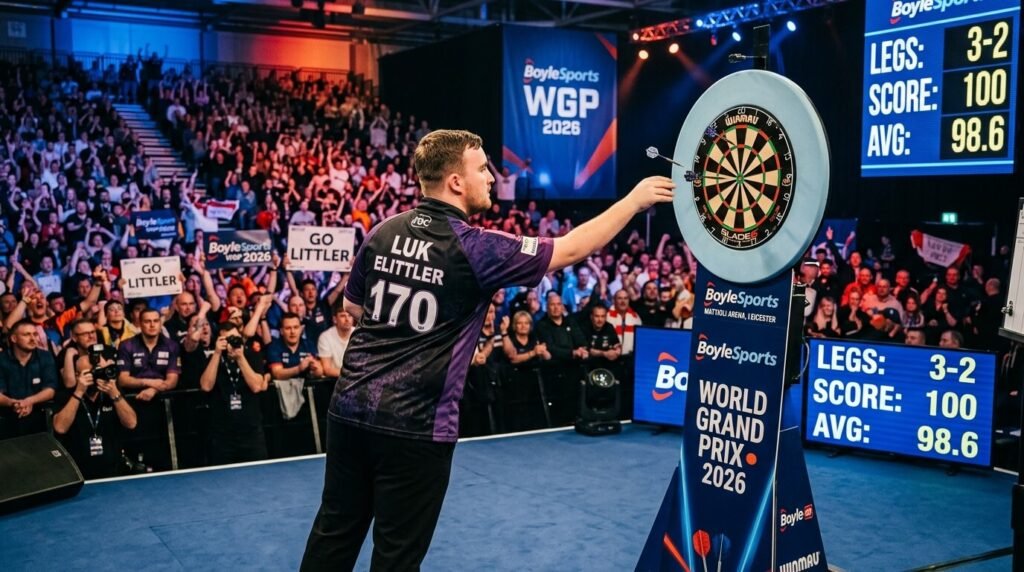

Few sports have transformed their public image as dramatically as darts. Once dismissed as a smoky pub pastime, it has grown into a slick, prime-time television spectacle complete with walk-on entrances, roaring crowds, and players earning significant prize money at major tournaments. This guide explains how the sport works, why it has become so popular, and what to look out for if you are new to watching competitive darts.
Latest Sports News
The Basic Rules of Darts
Darts is played on a circular board divided into twenty numbered segments, each split into single, double, and treble scoring areas, with a bullseye at the centre worth 50 points and an outer bull worth 25. Players throw three darts per turn from a standard distance, known as the oche, and the standard professional format is 501, where each player starts with 501 points and works their way down to exactly zero.
The catch is that a player must finish on a double, meaning the final dart thrown has to land in a double segment or the bullseye. This requirement adds a significant layer of strategy, since players must plan their scoring throughout a leg to leave themselves a favourable finish, known as a checkout, rather than simply throwing for the highest score available on every visit to the board.
Scoring, Averages and Checkouts
Professional players are often judged by their three-dart average, which measures the average score achieved across each set of three darts thrown. Elite players regularly average in the high 90s or above 100, a remarkable achievement given the precision required to consistently hit small target areas from over two metres away under pressure.
Checkout percentage is another key statistic, reflecting how often a player successfully finishes a leg when given the opportunity. Big checkouts, particularly finishes of 100 or more, are among the most celebrated moments in the sport, requiring not just accuracy but calm nerves and quick mental arithmetic under intense pressure.
Latest Sports News
Major Tournaments and Formats
Darts calendar is built around a series of major ranking events, with a world championship held annually as the sport’s showpiece tournament, drawing huge television audiences over the festive period. Matches in these events are contested over sets and legs, with players needing to win a set number of legs to claim a set, and a set number of sets to win the match, adding tension as contests progress through multiple rounds.
Beyond the majors, a busy calendar of televised events keeps players competing throughout the year, each contributing to world ranking points that determine seedings and qualification for the biggest tournaments. This structure rewards consistency across a long season rather than a single standout performance.
Why the Sport Has Exploded in Popularity
Part of darts’ appeal lies in its accessibility. Unlike many sports that require significant physical conditioning, darts can be played and understood by almost anyone, which makes it easy for casual viewers to relate to what they are watching. The sport also thrives on its unique atmosphere, with fans in fancy dress creating a raucous, carnival-like environment that television producers have leaned into heavily, turning arena darts into genuine entertainment events rather than purely sporting contests.
The emergence of charismatic players with distinct nicknames and walk-on entrances has also helped build storylines and rivalries that draw in viewers who might not otherwise follow the sport closely. Social media clips of outrageous nine-dart finishes or dramatic deciding-leg finishes have further expanded the sport’s reach to younger audiences around the world.
What to Watch For as a New Fan
New viewers should pay attention to how players set up their scoring shots. A common strategy is to aim for the treble 20 segment, worth 60 points, on scoring throws, before shifting attention toward the outer ring for a checkout once a player’s remaining score falls within reach of a double finish. Watching how a player adjusts their target depending on the remaining score reveals a surprising amount of on-the-fly mental calculation happening between throws.
It is also worth paying attention to momentum swings within a match. Because legs can turn quickly on a single missed double or a bold 170 checkout, darts matches often feature dramatic reversals of fortune that keep contests unpredictable right up until the final dart is thrown.
The Sport’s Growing Global Reach
While darts remains especially popular in the United Kingdom, its international footprint has grown substantially, with players from across Europe and beyond now competing at the top level. This globalisation has raised the overall standard of competition and introduced fresh rivalries that have helped sustain interest in the sport season after season.
Ultimately, darts combines precision, psychology, and showmanship in a way few other sports manage, and once you understand the scoring logic and strategic decisions behind each throw, it becomes easy to see why millions of fans now tune in to watch players battle it out on the oche.