



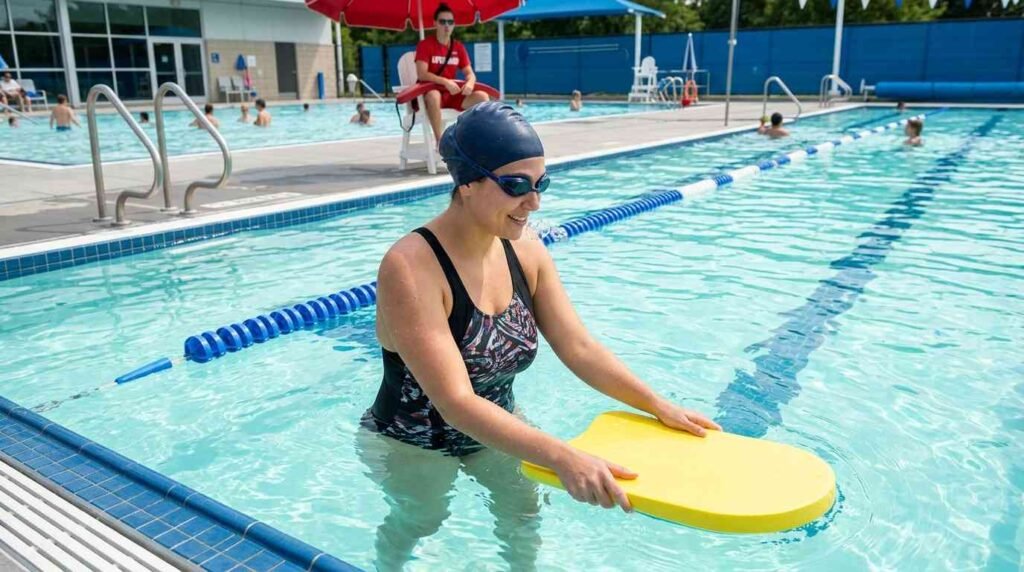
Swimming is a life skill, a full-body workout, and a lifelong hobby in one. Yet many people feel nervous the first time they step into a pool. Anyone searching for swimming tips for beginners usually wants to know how to stay safe, which skills to learn first, what gear to buy, and what a simple practice plan looks like. If that sounds like you, relax. This guide shows you exactly how to start, what to practice, and what to avoid.
You do not need to be athletic, young, or fearless. You can start swimming at any fitness level or age, as long as you work at your own level and keep things simple. What matters is a safe setup, good basics, and regular practice.
This guide has four parts: safety and mindset, gear, core skills, and training. It also includes a four-week starter plan, common mistakes, and answers to frequently asked questions. Read it once, then take it to the pool with you.
Quick Answer: Swimming Tips for Beginners at a Glance
- Safety first: Never swim alone, choose a lifeguarded pool, and stay where you can stand until you are confident.
- Best first skills: Blowing bubbles, rhythmic breathing, and floating on your back.
- Easiest strokes to start with: Freestyle (front crawl) and backstroke.
- Must-have gear: Well-fitting goggles. A swim cap, kickboard, pull buoy, and fins are optional helpers.
- Most common mistakes: Holding your breath, lifting your head, and kicking too deep or too hard.
- How often to practice: About three short sessions a week works well for most beginners.
- Biggest secret: Focus on technique and relaxation, not on speed or distance.
Why Swimming Tips for Beginners Matter
Good beginner habits protect you in the water and make swimming far more enjoyable. Let us look at both sides: the health benefits and the safety reasons.
The Health Benefits
Swimming is a gentle but powerful exercise. It keeps your heart rate up, builds muscle strength, and can be a great stress reliever. A Mayo Clinic sports medicine specialist also points out that swimming is easy on the joints and very good for heart health and core strength.
Harvard Health adds a useful comparison. Recreational swimming burns about the same calories as brisk walking, and water’s buoyancy takes stress off your joints. That makes swimming a great option for people who find running or walking uncomfortable. For more detail, read Harvard’s article on exercising in water and the Mayo Clinic guide to swimming for better health. National Geographic and GoodRx also explain the benefits for heart, lungs, and mood.
The Safety Reasons
Learning to swim is also about staying safe. The World Health Organization says there are around 300,000 drowning deaths worldwide each year, and children under five account for nearly a quarter of them. You can read the full WHO drowning fact sheet and learn about World Drowning Prevention Day, held every 25 July.
The Red Cross adds that a survey found more than half of Americans (54 percent) either cannot swim or lack some basic swimming skills. In other words, you are far from alone if you are just starting. The CDC’s swimming safety guidelines are another useful resource.
Swimming Tips for Beginners: Safety and Mindset (Tips 1-5)
Start here. Confidence and safety come before technique.
1. Learn Water Safety Before You Learn Strokes
Before you practice any stroke, learn the basic rules. The Red Cross advises that you never swim alone, and only swim with lifeguards or water watchers present. It also recommends that you swim in designated areas supervised by lifeguards.
If you ever need to help someone in trouble, remember the rescue rule: “reach or throw, don’t go.” Never jump in to save another person unless you are trained. Browse the Red Cross swim safety tips and the Red Cross water safety hub for more.
2. Stay Within Your Depth
As a beginner, stay in water where you can stand comfortably. Public health guidance suggests that non-swimmers should avoid water deeper than chest level. Stay close to the wall, and only move to deeper water once you can float, tread water, and swim a short distance.
One practical trick is to swim along the side of the pool rather than across the middle. That way, you can always reach the wall in a few strokes.
3. Choose the Right Pool and the Right Time
Pick a pool with a lifeguard on duty and clear rules. Quiet hours are best because you can practice without splashing crowds. Many facilities also have a shallow area or a slow lane for beginners.
Also, check the pool’s condition. Health officials suggest you check whether the latest inspection results are posted online or on-site before you use a public pool. A clean, well-managed pool is safer and more pleasant.
4. Take Lessons From a Qualified Instructor
You can learn a lot from articles and videos, but a real instructor gives feedback no video can. A professional swim instructor provides personalized instruction and feedback that matches your skill and needs.
Lessons also help you avoid bad habits early. Repeated motions become muscle memory, so starting with the correct technique matters, and unlearning wrong form later can be hard. Look for programs such as Red Cross swim classes. For children, the impact is even bigger: formal swim lessons can reduce drowning risk by 88% for one- to four-year-olds. You can read more in this Red Cross swim season release.
5. Overcome Fear of Water Gradually
Fear of water is very common among adult beginners. The best cure is slow, repeated exposure. Start in shallow water where you can stand, then practice putting your face in and breathing out underwater.
If you feel anxious, try these steps:
- Hold the wall and dip your face in and out while blowing bubbles.
- Exit the pool and take 20 slow, deep breaths.
- Focus on one small technique instead of the whole stroke.
Concentrating on stroke technique can also distract you from nervous feelings. The MySwimPro adult beginner guide and the Into the Swim adult beginner article both offer more ideas for building confidence.
Swimming Tips for Beginners: Gear You Actually Need (Tips 6-8)
You do not need expensive equipment. A few basic items make practice more comfortable and more effective.
6. Buy Goggles That Fit Well
Goggles are the most important piece of gear. They protect your eyes from chlorine, let you see the wall and other swimmers, and make it easier to develop a breathing rhythm.
To test the fit, press the goggles gently onto your eye sockets without using the strap. If they stay in place for a moment from suction, the seal is good. Then adjust the strap so they feel snug but not painful. For outdoor swimming, mirrored lenses can help in bright conditions.
7. Wear a Comfortable Swimsuit and Consider a Cap
Choose a suit that fits well and lets you move freely. A suit made mostly of polyester resists chlorine and lasts longer. A swim cap is optional, but it helps if you have long hair. A cap keeps hair out of your face and can extend the life of your goggles. Silicone caps are a popular choice.
8. Use Training Aids Wisely
Kickboards, pull buoys, and fins can speed up your progress. Here is what each does:
- Kickboard: Isolates your legs and gives your arms a rest.
- Pull buoy: A foam float between your thighs that lifts your hips so you can focus on your arms.
- Fins: Give extra push so you can focus on technique.
Training aids accelerate progress and are not cheating. However, do not depend on them forever. One coach advises that you should use fins to get used to breathing technique, but also practice swimming without them.
Swimming Tips for Beginners: Core Skills (Tips 9-19)
Now for the fun part. These are the building blocks of every stroke.
9. Get Comfortable With Your Face in the Water
Many beginners struggle simply because they dislike getting their face wet. Fix this first. Hold the pool wall and put your face in for a few seconds. Then lift, breathe, and repeat. You can blow bubbles through your nose, or use your hand to block your nose at the start.
Over a few sessions, increase the time until you can stay under calmly for five to ten seconds. This small skill makes everything else easier.
10. Learn Rhythmic Breathing
Breathing is one of the hardest parts of swimming for beginners. The good news is that you can practice it without swimming at all. U.S. Masters Swimming explains that the goal is rhythmic breathing: exhale when your mouth is underwater and inhale when it is above the surface.
A classic drill is the “bob.” Push off the bottom of the pool so your head just breaks the surface, take a quick breath, then sink back down and repeat. The USMS freestyle breathing guide walks through it step by step.
Above all, never hold your breath. Exhaling continuously underwater helps with buoyancy and relaxation. The WeAquatics breathing guide and Rocket Swimming’s breathing tutorial offer extra drills.
11. Learn to Float on Your Back
Floating is the most important survival skill you can learn. Back floating conserves energy, lets you breathe normally, and reduces panic in emergencies.
Follow these steps:
- Lie back in the water with your ears submerged.
- Spread your arms and legs like a starfish.
- Breathe deeply and relax every muscle.
- Keep your eyes pointed up at the ceiling or sky.
Tension, a tucked chin, shallow breathing, and keeping the body too compact are the four most common reasons beginners cannot float. The good news is that most adults achieve a basic back float within two to five practice sessions. See the SwimOutlet floating guide and the Big Blue Swim School back float guide for more.
12. Practice the Front Float and Body Position
Next, learn to float face down. The prone float, face down with arms extended, is the building block for freestyle and breaststroke body position.
Good body position keeps you streamlined. Do not let your hips sink, and look at the pool bottom, not forward. Looking forward lifts your head and drops your legs, which creates drag. Think of your body as a long, straight line from head to toe.
13. Learn to Kick Correctly
Kicking gives you balance and forward push. A simple way to start is at the wall. Hold the side of the pool, let your body float up, and kick while keeping your upper body above the water.
Then avoid these common errors:
- Kicking too deep: Deeper kicks create more resistance and are harder to keep smooth, so kick closer to the surface.
- Bending the knees too much: Kick from your hips with relaxed ankles.
- Making big splashes: A small, quick flutter kick works better than a loud, heavy one.
Also remember that your legs are not dead weight; a firm kick is needed for efficient technique.
14. Learn to Tread Water
Treading water keeps you upright with your head above the surface. You use arm sculling and an eggbeater or flutter kick, and it takes more energy than back floating. It is essential for moments when you cannot lie flat, such as in waves or crowded water.
The Red Cross lists treading water as part of basic water competency. Its five-step skill set includes entering water over your head, floating or treading for one minute, turning in a circle to find an exit, swimming 25 yards, and exiting. Read the details in this Red Cross water competency release.
15. Start With Freestyle
Freestyle, also called front crawl, is the most popular stroke. It combines a continuous arm movement with flutter kicks and side breathing.
Break it down into small parts:
- Kick on your front holding a kickboard.
- Add one-arm drills.
- Combine both arms with the kick.
- Add side breathing last.
The U.S. Masters Swimming beginner guide explains the stroke clearly, including the gentle body rotation that makes breathing easier than staying flat.
16. Try Backstroke
Backstroke is a friendly option because your face stays out of the water. It is a great choice for beginners since your face remains above the surface. You can breathe whenever you like.
Keep your body rotating gently, tilt your pelvis up, and flick your toes at the surface without a big splashy kick. Backstroke also rests your neck and shoulders after freestyle.
17. Add Breaststroke for Variety
Breaststroke is slow, steady, and easy to breathe with. It uses a simultaneous arm pull, a frog-style kick, and a glide. Many beginners find it relaxing because your head can stay above water for longer.
Mixing strokes is smart. Each stroke works different muscle groups, and switching helps you become a well-rounded swimmer. Likewise, freestyle, breaststroke, and backstroke are enough at the beginning, and alternating them rests different muscles. Butterfly can wait.
18. Roll Your Head, Do Not Lift It
A very common freestyle mistake is lifting the head to breathe. The slightest lift makes your legs sink. Swim coaches explain that there is a clear difference between rolling the head to the side and lifting to look to the side.
Try this instead. Rotate your head just enough to breathe, keeping one eye in the water, and keep your head in line with your body. Your body rotation from the core does most of the work. For more on this, see Swim-Teach on floating in freestyle.
19. Relax and Coordinate Your Movements
At first, your arms and legs will feel out of sync. That is normal. Beginners often chop through the water with all limbs, and it takes time to get a feel for how they should move.
Slow down and relax. Smooth, calm strokes travel farther than fast, tense ones. Be consistent and patient, and try again next time if something does not work right away. The YMCA guide to basic swimming skills has helpful coordination tips too.
Swimming Tips for Beginners: Training Smart (Tips 20-25)
Skills grow through practice. These tips help you train safely and steadily.
20. Warm Up and Start Short
Never jump into hard swimming. Start each session with easy, low-intensity swimming, just as you would warm up before lifting weights.
Keep early sessions short, around 20 to 30 minutes. As one coach reminds beginners, focus on stroke, breathing, and kicking technique rather than how far or how fast you swim. Tired arms are normal at first, so do not feel discouraged.
21. Follow a Simple Workout Structure
A structured session keeps you focused. Every good swim workout follows the same three parts: warm-up, main set, and cool-down. The plan below uses this pattern. For extra ideas, see SwimSwam’s beginner workouts, the SwimOutlet beginner sessions, and the GoodRx beginner swim workouts.
22. Increase Distance Gradually
Do not add too much too soon. A good rule is to increase your distance by no more than 10% per week. Overdoing it can hurt your shoulders. A Mayo Clinic specialist notes that most swimming injuries are overuse injuries caused by improper form, overtraining, and poor use of core muscles. Shoulder pain is so common in swimmers that the condition is known as “swimmer’s shoulder.” If you feel sharp pain, stop and rest.
23. Rest, Hydrate, and Fuel Your Body
You are surrounded by water, but you still sweat. Drink plenty of water and take breaks, even though you are submerged. Also give your body recovery time. Try to leave a day or two between sessions.
After each swim, dry your ears well. The CDC notes that drying your ears thoroughly helps prevent swimmer’s ear.
24. Be Consistent
Regular practice beats occasional long sessions. One fitness site suggests you start with 10 sessions of easy, steady swimming over three weeks, after which your body begins to adapt. That works out to about three sessions a week.
Track your progress in a notebook or app. Small wins such as your first back float or your first full length add motivation.
25. Learn Open Water Skills Before You Leave the Pool
Lakes, rivers, and the sea are very different from pools. The Red Cross warns that being water competent in natural water takes additional knowledge and skills compared with a pool. Hazards include fast currents, waves, rapids, and underwater obstacles like rocks and debris. If thunder starts, leave the water immediately and stay inside for at least 30 minutes after the last thunder clap.
Read the Red Cross lake and river safety tips before your first open-water swim. Until then, stick to lifeguarded areas and wear a Coast Guard-approved life jacket when boating.
What to Expect at Your First Swim Session
Your first visit is easier when you know what will happen. Most beginners spend the first session getting used to the water, not swimming laps. That is completely normal and a good sign that you are taking the right approach.
Arrive 10 to 15 minutes early so you can change, shower, and look around the pool without rushing. Tell the lifeguard or your instructor that you are new to swimming. They can point you to the best lane or shallow area and keep an eye on you.
Use this checklist before you leave home:
- Swimsuit, goggles, and a towel: These are the basics for every session.
- Swim cap (optional): Helpful if you have long hair.
- Lock for your locker: A good idea at public pools to keep your belongings safe.
- Water bottle: You sweat in the pool, so stay hydrated.
- Flip-flops: They keep your feet clean and safe on wet floors.
- A simple goal: For example, “blow bubbles ten times” or “float on my back for five seconds.”
Once you are in the water, begin at the shallow end. Practice bubbles, then a few bobs, then a short back float while holding the wall. Stop before you feel exhausted, and finish with a slow stretch on the pool deck. Ending on a positive note builds confidence for the next visit.
Beginner Swimming Plan: A Simple 4-Week Schedule
Use this plan three times a week. One “length” means swimming from one end of the pool to the other. Rest as long as you need between sets. If you have a medical condition, speak to a doctor before you start.
| Week | Session length | Warm-up | Main set | Cool-down |
|---|---|---|---|---|
| 1 | 20 minutes | Walk in shallow water, blow bubbles, do 10 bobs | 4 x wall kicking (20 seconds each) + practice back float 4 times | Easy walking and stretching |
| 2 | 25 minutes | 5 bobs, 2 back floats | 6 x 1 length kick with a board, resting 30 seconds after each | 2 lengths easy backstroke |
| 3 | 30 minutes | 2 lengths easy kick | 4 x 1 length freestyle with breathing, resting 30 seconds; 4 x 1 length backstroke | 2 lengths easy swim |
| 4 | 30-35 minutes | 2 lengths easy swim | 6 x 2 lengths alternating freestyle and backstroke, resting 30 seconds; 2 lengths pull buoy | 2 lengths easy swim, then stretch |
For added variety, DanSwim’s beginner workouts, City Fitness lap swimming ideas, Swimply’s workout plans, and Your Swim Log’s workout library are all helpful.
Common Swimming Mistakes Beginners Should Avoid
Even with good swimming tips for beginners, some mistakes creep in. Watch for these:
- Holding your breath: It makes you tense and tired. Exhale steadily instead.
- Lifting your head: This drops your legs and creates drag.
- Kicking from the knees or too deep: It wastes energy and adds little speed.
- Swimming too fast: Speed breaks technique. Beginners should focus on technique first and foremost.
- Skipping the warm-up: Cold muscles tire fast and get sore.
- Going into deep water too soon: Stay within your depth until your skills are solid.
- Ignoring rest days: Recovery helps your body adapt.
The DanSwim guide to beginner mistakes and the Fast Swim Academy’s 12 basic tips cover more of these errors.
Swimming Tips for Beginners by Age Group
The basics stay the same at every age, but the approach changes a little. Here is how to adapt these swimming tips for beginners to your situation.
Adult Beginners
Many adults feel embarrassed about starting late. Remember that it is never too late to learn, and most swim schools run adult-only classes. Choose quiet pool hours, wear a swimsuit you feel comfortable in, and set small goals. Your first wins will likely be bubbles, a back float, and a short glide.
Parents Helping Children Learn
Children need constant, close supervision around water, even when a lifeguard is present. Health officials advise staying within arm’s reach of a small child. Keep sessions short and playful, and use songs and games to build comfort with bubbles and floating. Enroll your child in a formal program when they are ready, because lessons add an important layer of protection.
Older Beginners and Joint Comfort
Water is a friendly place for people with sore joints because buoyancy supports your weight. Mayo Clinic notes that aquatic exercise is a helpful way for older adults to stay active, and you can even start with water walking before you swim. Go slowly, choose a warm pool, and speak to your doctor if you have heart, breathing, or joint conditions.
Pool Hygiene and Healthy Swimming Habits
Healthy habits protect you and other swimmers. The CDC and public health agencies recommend these steps:
- Shower before you enter the pool.
- Stay out of the water if you have diarrhea, and do not swallow pool water.
- Stay out of the water if you have an open cut or wound.
- Check for swim warnings or closures posted near the water or online.
Find more at the CDC Healthy Swimming hub and the CDC page on preventing swimming-related illnesses.
Swimming Tips for Beginners: Frequently Asked Questions
Q: How long does it take to learn to swim as a beginner?
A: It depends on your comfort level and practice. Many adults learn a basic back float in two to five sessions. Building a full freestyle stroke with breathing usually takes several weeks of regular practice, often about three sessions a week.
Q: What should a beginner learn first in swimming?
A: Start with putting your face in the water, blowing bubbles, and rhythmic breathing. Then learn to float on your back, kick, and glide before you add arm strokes.
Q: What is the easiest swimming stroke for beginners?
A: Freestyle and backstroke are the easiest starting points. Backstroke keeps your face above water, while freestyle teaches the core skills you will use in most other strokes.
Q: Why do my legs sink when I swim?
A: Legs usually sink when your head is too high, your hips drop, or you tense up. Keep your gaze on the pool floor, roll your head to breathe, and use a pull buoy or fins occasionally to feel the right position.
Q: Should I hold my breath while swimming?
A: No. Exhale slowly underwater and inhale quickly when your mouth clears the surface. Steady breathing keeps you relaxed and helps you float.
Q: How can I overcome my fear of water?
A: Go slowly. Start in shallow water, blow bubbles while holding the wall, and add one new skill at a time. Lessons with a patient instructor can also make a big difference.
Q: What gear do I need to start swimming?
A: Goggles are the essential item. A swimsuit that fits well is next. A swim cap, kickboard, pull buoy, and fins are helpful but optional.
Q: Is swimming good for people with joint pain?
A: Swimming is usually gentle on the joints because water supports your body weight. However, always check with your doctor first if you have a medical condition or pain. Mayo Clinic’s aquatic exercise guide explains that you can even do aquatic exercise without knowing how to swim.
Q: How many calories does swimming burn?
A: It depends on your weight, pace, and stroke. Harvard Health says recreational swimming burns about the same as brisk walking. Harder or faster swimming burns more.
Q: Can beginners swim in open water?
A: Not until you have good pool skills. Natural water has currents, cold spots, and hidden hazards. Swim only in lifeguarded areas and never alone.
Swimming Tips for Beginners
Learning to swim is a journey, not a race. Start with safety, build comfort with breathing and floating, and add strokes one at a time. Use the gear that helps, follow a simple weekly plan, and rest when you need to. Above all, be patient with yourself.
Keep these swimming tips for beginners handy, practice regularly, and consider lessons with a qualified instructor. In a few weeks, you will be surprised by how confident you feel in the water. Bookmark this page and return whenever you need a refresher.
Health note: This article is for general information only. If you have a medical condition, check with a healthcare professional before starting a new exercise routine.
Sources and Further Reading (Backlinks)
The safety guidance, health information, and technique tips in this guide are drawn from public-health agencies, medical institutions, and swimming organizations. For deeper reading and ongoing updates, see:
- WHO — Drowning (Fact Sheet)
- WHO — World Drowning Prevention Day
- CDC — Guidelines for Healthy and Safe Swimming
- CDC — Preventing Swimming-related Illnesses
- CDC — Healthy Swimming Hub
- American Red Cross — Swimming Safety
- American Red Cross — Water Safety
- American Red Cross — Lake and River Swimming Safety
- American Red Cross — Swim Classes & Training
- American Red Cross — Swim Season Is Here: Critical Water Safety Tips for Children and Families
- American Red Cross North Texas — Vigilance and Strong Swimming Skills as Keys to Water Safety
- Mayo Clinic Orthopedics & Sports Medicine — Swimming for Better Health and to Avoid Injuries
- Mayo Clinic — Aquatic Exercises
- Harvard Health — Exercising in Water: Big Heart Benefits and Little Downside
- Harvard Health — Take the Plunge for Your Heart
- National Geographic — Swimming Just Might Be the Best Exercise Out There
- GoodRx — 9 Benefits of Swimming for Fitness and Health
- GoodRx — 4 Beginner Swim Workouts That Are Expert Approved
- U.S. Masters Swimming — Swimming 101: The Beginner’s Guide to Swimming
- U.S. Masters Swimming — Freestyle Breathing: Swim Farther With Less Effort
- SwimOutlet — How to Float in Water: 8-Step Guide for Every Body Type
- SwimOutlet — Swim Workouts for Beginners: Three Structured Sessions
- SwimSwam — 5 Swim Workouts for Beginners
- Big Blue Swim School — How to Float on Your Back
- Rocket Swimming — How to Perfect Your Freestyle Breathing
- WeAquatics — Master the Basics of Breathing in Swimming
- Swim-Teach — How To Float When Swimming Freestyle
- DanSwim — Swimming Mistakes: Tips for Beginners Who Just Started Swimming
- DanSwim — Beginner Swim Workout From a Professional Swim Coach
- YMCA of Greater Philadelphia — Swimming for Beginners: 6 Basic Skills
- MySwimPro — 10 Beginner Swim Tips for Adults
- Into The Swim — Adult Beginner? No Problem! Tips for Mastering the Basics of Swimming
- Gold Medal Swim School — Top Beginner Swim Tips for Kids and Adults
- Eat Smart, Move More, Weigh Less — How to Start Swimming: Tips for Beginners
- Fast Swim Academy — Basic Swimming Tips: 12 Tips From Pro Swimmers
- City Fitness — Lap Swimming Workouts for Beginners
- Swimply — 20 Swim Workouts: Beginner, Intermediate & Advanced Plans
- Your Swim Log — 27 Workouts for Swimmers
Every link above is directly relevant to swimming, water safety, or beginner training. Quality and relevance matter more than link count, so when you update this article, replace outdated links rather than adding unrelated ones.
About This Guide and Medical
This guide is written for general education. It brings together safety guidance from public-health agencies and technique advice from swimming coaches and organizations, and it is meant to complement, not replace, hands-on lessons with a qualified instructor. Swimming is generally gentle on the body, but if you have a heart condition, breathing problem, joint pain, or any other medical condition, check with a healthcare professional before you start a new exercise routine. Children must always be supervised closely around water.